
Sea Trial Mastery on the Chesapeake: What to Test, Measure, and Feel Before You Buy
A sea trial on the Chesapeake Bay is your best opportunity to move beyond glossy photos and spec sheets and understand how a yacht truly performs in your hands. Done well, it’s part test drive, part systems inspection, and part “lifestyle rehearsal” in real Bay conditions.
Below is a structured checklist to help you evaluate handling, noise, sightlines, docking, and onboard systems during your private appointment—so your decision is both confident and data-driven.
Before You Leave the Dock: Set Up a Smart Sea Trial
Arrive with a simple plan and a short list of non‑negotiables.
Bring:
- A notepad or notes app
- Noise meter app (optional but useful)
- Phone/camera for quick photos of details
- Crew or family members who will regularly be aboard
Confirm with your broker or captain:
- Fuel and water levels (affect performance)
- Number of people on board
- Intended route and duration
- Sea state and forecast (you want “real,” not risky, conditions)
Clarify your primary use case:
- Weekending on the Bay?
- Longer coastal runs to New England or the Carolinas?
- Day boating and entertaining locally?
Share this with your Chesapeake Yacht Center consultant so the trial can mirror how you’ll actually use the yacht.
Handling and Ride: How the Yacht Behaves on the Bay
1. Acceleration and Trim
Once clear of the no‑wake zone:
- Bring the boat smoothly from idle to planing speed.
- Note time to plane and whether the bow rise blocks your view.
-
Adjust trim tabs and engine trim, feeling for:
- Bow settling into a comfortable running attitude
- Reduction in pounding or spray
- Changes in fuel burn (if data is available)
Ask yourself:
- Does the yacht feel confident, or does it labor to get on plane?
- Is the transition from displacement to planing smooth and controlled?
2. Tracking and Steering Response
At a comfortable cruise speed (~70–80% of rated RPM):
-
Run on a straight heading and release your grip slightly:
- Does the boat track straight or wander?
-
Make gradual turns, then tighter turns:
- How does the hull respond—predictable, or twitchy?
- Do you feel secure when banking into a turn?
Test:
- Low-speed steering (5–8 knots) in open water
- Cruise-speed maneuvering around marks or known waypoints
Noise, Vibration, and Comfort: What You Hear and Feel
A quiet, composed yacht makes long Bay days far more enjoyable, especially in the changeable winds and chop the Chesapeake is known for.
1. Measure and Compare Noise Levels
Use a simple decibel meter app to benchmark noise in key zones:
- At idle, in the cockpit and salon
- At typical cruise RPM
- At wide-open throttle (briefly, conditions permitting)
As a general comfort guide:
- Under ~70 dB: relaxed conversation without raised voices
- 70–80 dB: acceptable, but louder; consider if you cruise long distances
- Over 80 dB: tiring over time
Note where noise is coming from:
- Engine room insulation?
- Wind and hull noise?
- Hardtop, flybridge, or loose fittings?
2. Vibration and Resonance
Pay attention to:
- Subtle vibrations through the helm seat, floor, and tables
- Rattling doors, cabinetry, or loose panels
- Any “drone” frequencies at specific RPMs
Try walking from helm to cabins at cruise speed:
- Is conversation easy?
- Does the yacht feel solid, or are there distracting buzzes?
Sightlines and Helm Ergonomics: Seeing and Controlling with Confidence
On the Chesapeake, from narrow rivers to busy Annapolis weekends, visibility and helm comfort are crucial.
1. Forward and Aft Visibility
From the primary helm position:
-
Check sightlines with the boat:
- At idle
- Bow-up during acceleration
- On plane at cruising speed
Evaluate:
- Can you easily see channel markers, floating debris, and crab pots?
- Are there blind spots created by mullions, pillars, or electronics?
At idle and while docking:
-
Look aft and to the quarters:
- Can you see the swim platform or corners of the stern?
- Is there a clear view to both sides for backing into a slip?
2. Helm Layout and Comfort
You’ll spend many hours at this station. Confirm:
-
Seat position and adjustability:
- Can you drive comfortably seated and standing?
- Is there a secure footrest?
-
Control placement:
- Throttles and joystick within natural reach
- Bow and stern thrusters (if equipped) easy to use together
-
Visibility of instruments:
- Readable screens in bright sun
- Critical data (speed, depth, fuel, RPM, GPS) visible at a glance
Ask to simulate:
- Night operation (if possible, dim displays and review lighting)
- Heavy rain or spray (discuss wiper performance and defogging)
Docking and Close-Quarters Control: Stress Test the Maneuvering
For many owners, docking in tight Chesapeake marinas is the most anxiety‑inducing part of ownership. Use the trial to de‑stress this for good.
1. Slow-Speed Maneuverability
In a controlled area:
- Practice shifting in and out of gear at idle.
- Use small throttle bumps to see how the boat reacts.
-
Test:
- Pivot turns (using engines and thrusters)
- Side‑to‑side crabbing (with joystick, if equipped)
- Reverse tracking—does the transom wander or stay true?
Judge:
- Predictability: Does the yacht respond consistently?
- Power: Is there ample authority to overcome wind and current?
2. Realistic Docking Scenario
If conditions and marina traffic allow, ask to:
- Back into a slip or alongside a T‑head
- Execute a controlled departure
Pay attention to:
- Response to wind on the bow or stern
- Line handling and cleat placement
- Communication between helm and crew—does the layout support it?
Visualize your home slip or regular marinas and ask:
- Will this configuration make arrivals and departures low‑stress?
Systems, Electronics, and Liveability: Beyond the Helm
A well‑run sea trial also evaluates the yacht as a floating home and social space.
1. Navigation and Electronics
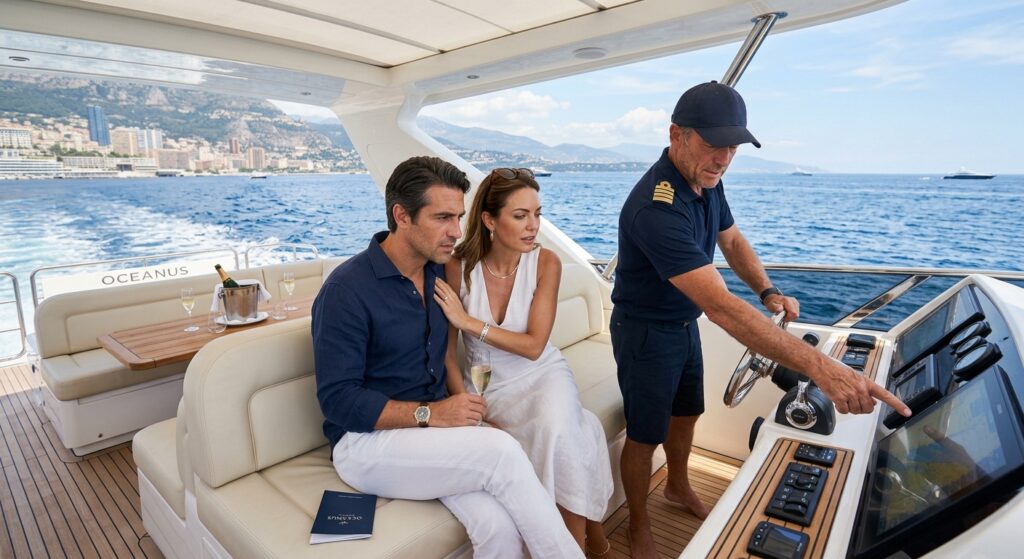
Underway, have the captain walk you through:
- Chartplotter, radar, and autopilot
- Depth sounder and bottom detail (critical for the Bay’s shallows)
- Camera systems and docking aids (if installed)
Confirm:
- You understand basic operation
- Screen layouts are intuitive
- Software and charts are current for the Chesapeake
2. Comfort and Utility Systems
While underway and at idle, ask to test:
- Generator start/stop and load handling
- Air conditioning in key areas (salon, cabin, helm)
- Stabilization systems (gyros or fins), if equipped
- Windlass and ground tackle (watch an anchor deploy and retrieve)
- Lighting, audio, and entertainment zones
Walk through the galley, heads, and cabins as the boat moves:
- Any unexpected doors swinging or drawers opening?
- Are handholds well‑placed for moving safely at sea?
Turning Impressions into Confident Decisions
After the sea trial, take 10–15 minutes with your consultant to debrief:
- List what impressed you most.
- Identify any concerns or “wish it did this better” items.
- Compare performance and feel against your planned usage.
- Review performance data (RPM vs. speed vs. fuel burn, if available).
A well‑documented trial transforms your purchase from emotional impulse into an informed, long‑term investment in your lifestyle on the Bay.
Experience a Concierge-Guided Sea Trial with Chesapeake Yacht Center
Chesapeake Yacht Center coordinates private, meticulously planned sea trials tailored to how you actually boat on the Chesapeake and beyond—from Annapolis day trips to offshore runs. Our team handles every detail, explains each system, and stays by your side well beyond delivery.
To schedule a personalized sea trial or discuss the right yacht for your cruising plans, contact Chesapeake Yacht Center in Baltimore today.