
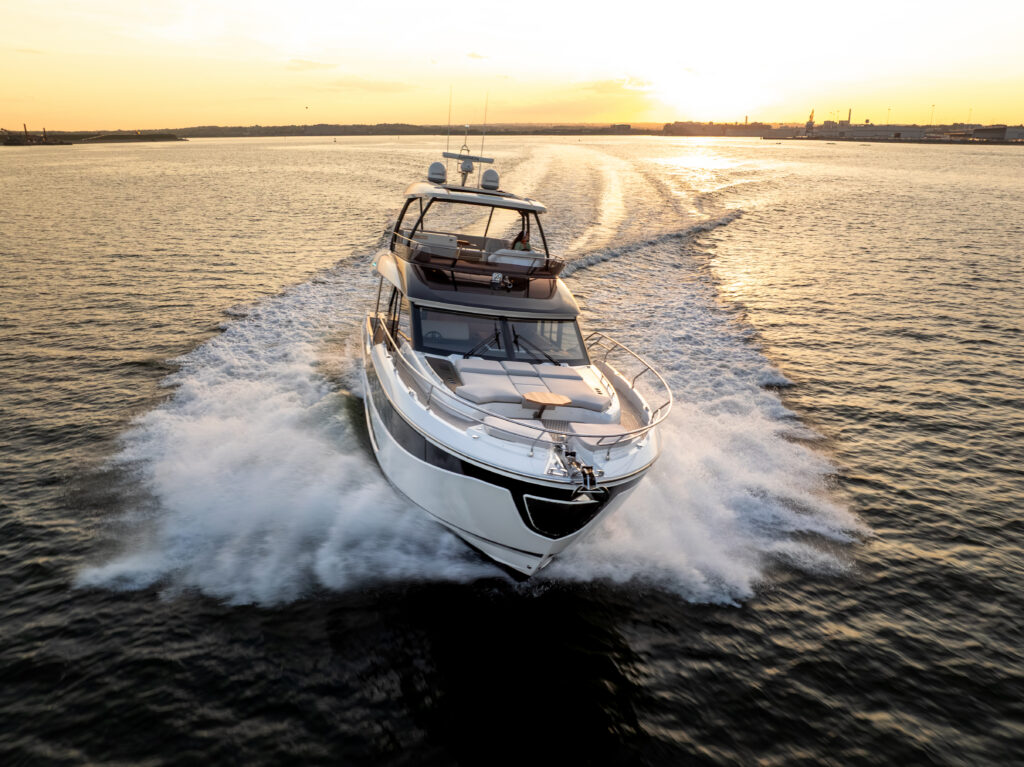
Beyond Horsepower: How Hull Design, Beam, and Displacement Shape Comfort, Speed, and Fuel Economy
Horsepower sells headlines—but it’s the hull beneath your feet that quietly defines how your yacht actually behaves on the water. For buyers comparing luxury yachts, focusing only on engines can lead to surprises in ride quality, range, and handling.
Understanding the interplay between hull design, beam, and displacement helps you choose a yacht that fits the way you truly cruise—whether that’s relaxed Chesapeake Bay weekends, offshore runs along the Atlantic, or extended coastal journeys.
Below, we’ll break down the key design elements that shape comfort, speed, and fuel economy, and how to think about them when evaluating yachts.
The Foundation: Hull Design and Ride Characteristics
A yacht’s hull is its underwater “architecture.” Even with identical horsepower, two yachts with different hulls will feel completely different.
Planing, Semi-Displacement, and Displacement Hulls
Most luxury motor yachts and express cruisers fall into one of three broad categories:
1. Planing hulls
Designed to rise and skim on top of the water at speed.
- Typical of: Many Prestige, Princess, Pardo, and Jeanneau powerboats
-
Strengths:
- Higher top speeds
- Quick acceleration and sporty handling
- Ideal for day cruising, island hopping, and covering distance fast in fair to moderate conditions
-
Trade-offs:
- Less efficient at slow speeds
- Ride can feel firmer in chop if not properly designed or trimmed
2. Semi-displacement (semi-planing) hulls
Blend characteristics of displacement and planing hulls.
- Typical of: Many modern cruising yachts that prioritize versatility
-
Strengths:
- Efficient and comfortable at moderate cruising speeds
- Better seakeeping than pure planing hulls in rougher water
- More flexible speed range for different conditions
-
Trade-offs:
- Lower top speed than a pure planing hull with the same power
3. Full displacement hulls
Stay in the water rather than rising up on top of it.
- Typical of: Long-range trawlers and expedition-style yachts
-
Strengths:
- Excellent fuel economy at slow speeds
- Gentle motion and strong seakeeping offshore
- Ideal for long-distance passagemaking
-
Trade-offs:
- Much lower top speeds
- Designed for those who value range and comfort over speed
Choosing between these hull types is less about “better or worse” and more about how and where you intend to use the yacht.
Comfort Underway: Deadrise, Hull Shape, and Stability
Within each hull category, details of the shape dramatically influence comfort.
Deadrise: How the V of the Hull Affects the Ride
Deadrise is the angle between the bottom of the hull and a horizontal line. In simple terms, it’s how deep the “V” is.
-
Higher deadrise (deeper V)
- Slices through waves more softly
- Generally provides a smoother ride at speed in chop
- Can feel more “tender” at rest (more roll at anchor)
-
Lower deadrise (flatter sections)
- More initial stability at rest and at low speed
- Can pound more in rough conditions at higher speeds
- Often more efficient at displacement and low planing speeds
Many premium builders—such as Princess and Prestige—use variable deadrise and carefully designed chines to balance soft ride, control, and stability, especially in coastal and offshore conditions.
Hull Form and Stabilization
Other aspects that affect comfort:
- Chines and spray rails: Help deflect spray and increase dynamic stability
- Strakes: Improve lift and tracking, aiding both efficiency and handling
- Stabilization systems (fins, gyros): Dramatically reduce roll at rest and underway, transforming comfort for family and guests
A sea trial in local Chesapeake Bay or Atlantic conditions is the best way to feel how a particular hull design translates into real-world comfort.
Beam: The Balance Between Space, Stability, and Speed
Beam is the width of the yacht at its widest point. Buyers often focus on beam for interior volume—but it’s just as important for how the yacht behaves underway.
How Beam Influences the Onboard Experience
Wider beam advantages:
- More interior and cockpit space
- Larger salons, more generous cabins, and wider side decks
- Greater initial stability—feels more solid underfoot at rest
- Often preferred for entertaining, liveaboard use, and family cruising
Wider beam trade-offs:
- More wetted surface area, which can increase drag
- Potentially lower top speeds and slightly higher fuel burn for a given engine package
- Can increase sensitivity to loading and trim
Narrower beam advantages:
- Can be more easily driven to higher speeds with the same power
- Often better fuel efficiency at planing speeds
- Sharper entry can enhance ride comfort in chop
For many Chesapeake Yacht Center clients, the “sweet spot” is a moderate-to-wide beam that delivers a generous, open layout without compromising efficiency and performance. This is one reason brands like Prestige and Princess are so popular—they maximize space while maintaining capable, efficient running surfaces.
Displacement: Weight, Momentum, and Real-World Efficiency
Displacement is the total weight of the yacht, including fuel, water, equipment, and furnishings. Two yachts with the same horsepower and similar hull shapes can perform very differently if one carries significantly more weight.
Heavier vs. Lighter Yachts
Heavier yachts:
-
Pros:
- More momentum for a solid, planted feel in a seaway
- Can ride more smoothly through chop due to mass
- Often built with more systems and amenities for comfort
-
Cons:
- Require more power to reach and maintain speed
- Can have higher fuel consumption at planing speeds
- Slower acceleration
Lighter yachts:
-
Pros:
- Quicker to plane and more responsive
- Generally better fuel economy at a given speed
- Sportier handling, ideal for performance-oriented owners
-
Cons:
- May feel more affected by wind and waves
- Ride can be more reactive in certain sea states
Premium builders use advanced materials, resin infusion, and structural engineering to reduce unnecessary weight while maintaining strength. This allows models from brands like Pardo and Cranchi to deliver impressive speed and efficiency without sacrificing comfort.
Matching Design to Your Cruising Style
Rather than chasing the highest horsepower, focus on how hull design, beam, and displacement complement your boating lifestyle.
Ask yourself:
-
Where will you cruise most?
Primarily the Chesapeake Bay? Offshore runs to the canyons? Coastal trips to New England or the Carolinas? -
How fast do you truly run?
Many owners find a comfortable, efficient cruise in the 18–26 knot range, even if the yacht is capable of more. -
Who is typically aboard?
Family with young children, entertaining clients, or long-range couples’ cruising? -
What matters more: Range, comfort, or top-end speed?
Your priorities drive whether a planing, semi-displacement, or heavier cruising hull makes the most sense.
Working with a knowledgeable yacht consultant—who understands both naval architecture and real-world Mid-Atlantic conditions—helps translate these preferences into the right hull form, beam, and displacement for you.
Experience the Difference with Chesapeake Yacht Center
At Chesapeake Yacht Center, we go far beyond quoting horsepower. Our team takes the time to understand how you cruise, then guides you through the nuances of hull design, beam, and displacement across our portfolio of Prestige, Princess, Pardo, Cranchi, Dyna, Jeanneau, and Navan models—as well as select pre-owned opportunities.
From personalized consultations and private showings on the Chesapeake Bay to tailored sea trials, financing support, delivery coordination, and hands-on training, we make every stage of yacht ownership seamless.
To explore which yacht design best matches your ideal cruising experience, contact Chesapeake Yacht Center today to schedule a confidential, one-on-one consultation.