
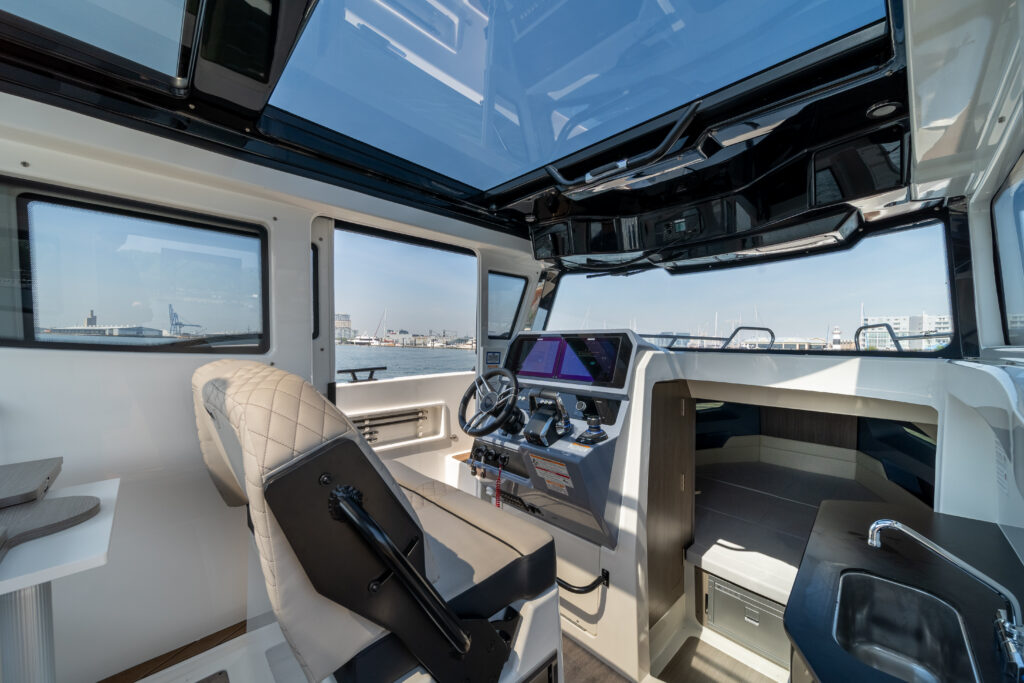
The Modern Motor Yacht Cockpit: Tech That Builds Real Confidence For Owner‑Operators
Stepping up in size to your first larger motor yacht should feel exciting—not intimidating. Today’s cockpits are designed to help owner‑operators handle more length, more horsepower, and more complexity with less stress, thanks to intelligent systems that simplify docking, navigation, and comfort underway.
At Chesapeake Yacht Center, we see firsthand which technologies genuinely shorten the learning curve and which upgrades pay dividends in confidence, safety, and resale value. This guide breaks down the essentials.
Joystick Docking: The Single Biggest Confidence Booster
For most new owners moving up in size, docking is the primary concern. Joystick control has changed that.
How Joystick Docking Works
Modern joystick systems integrate:
- Engines and gearboxes (or pods)
- Bow and/or stern thrusters
- GPS position holding (on some systems)
- Autopilot and steering
Instead of juggling throttles and a wheel, you simply:
- Push the joystick sideways to move the boat laterally
- Twist to rotate on axis
- Push forward or back to move in or out
The system blends thrust automatically to execute your command.
Why It Shortens the Learning Curve
Joystick docking is particularly valuable when:
- Moving from 30–40 feet up to 45–65 feet
- Operating in tight Mid‑Atlantic marinas with current and wind
- Docking short‑handed or with less experienced crew
Benefits include:
- Dramatically faster skill acquisition
- Less stress in front of spectators on the dock
- Greater willingness to use the boat more often
When Joystick Is “Worth It”
On new builds and late‑model brokerage yachts, joystick docking is one of the best investments you can make if:
- You plan to owner‑operate without a captain
- You frequently move slips, visit new marinas, or cruise unfamiliar ports
- Your home marina has strong crosswinds or tight fairways
On some pre‑owned vessels, joystick retrofit kits are available, but compatibility varies. A professional evaluation is essential before deciding to install on an existing boat.
Active Stabilization: Comfort That Expands Your Cruising Range
As yachts grow in size and capability, owners naturally want to explore more—and that often means rougher conditions. Active stabilization systems keep the boat more level, reduce rolling, and make time on the water more enjoyable.
Types of Stabilization You’ll See
Common systems on modern motor yachts include:
-
Gyroscopic Stabilizers (SeaKeeper, Quick Gyro, etc.):
Heavy spinning flywheels inside a sealed unit that counteract roll. -
Fin Stabilizers:
Hydrodynamic fins mounted to the hull that adjust position to resist rolling, especially effective at higher speeds. -
Interceptors and Trim Systems:
While mainly for pitch and running attitude, some systems help soften the ride and improve handling.
Why Stabilization Builds Confidence
Reduced roll is not just about comfort:
- Less fatigue for the operator on longer passages
- More comfortable guests and family, especially those prone to seasickness
- Greater confidence to leave the dock, knowing you can handle a choppy day on the Bay or coastal runs along the Atlantic
For many families, stabilization is the difference between a yacht that gets used occasionally and a yacht that becomes the center of their lifestyle.
Is Stabilization Worth the Upgrade?
In the 45–70 foot range, stabilization is increasingly expected equipment—both for comfort and resale. Consider it a high‑value upgrade if:
- You cruise the Chesapeake Bay during windy shoulder seasons
- You plan open‑water runs (e.g., to New England or the Carolinas)
- You regularly entertain guests who aren’t seasoned boaters
On new yachts from brands like Prestige, Princess, Pardo, Cranchi, Dyna, Jeanneau, and Navan, stabilization is often available from the factory. Gyro retrofits on select pre‑owned models can also be excellent investments if the hull and electrical systems are compatible.
Integrated Navigation: A Smarter, Simpler Helm
Today’s helm stations consolidate what used to be a wall of disconnected instruments into a clean, intuitive interface. Done correctly, integration makes your yacht easier and safer to operate.
Key Elements of an Integrated Helm
A modern, owner‑operator‑friendly cockpit typically includes:
- Large multifunction displays (MFDs) for charts, radar, sonar, cameras, and engine data
- Autopilot with route following and track hold
- Digital switching for lights, pumps, and systems
- Engine and fuel data integration right on your displays
- AIS (Automatic Identification System) to track commercial and recreational traffic
With a well‑designed helm, you can monitor position, depth, traffic, weather, and engines at a glance, reducing cognitive load and allowing you to focus on safe piloting.
Which Navigation Upgrades Matter Most?
For owners moving up, focus on:
- Clear, daylight‑viewable displays: Two large MFDs are ideal for redundancy and flexibility.
- Radar integration: Critical for fog, night passages, and busy shipping lanes.
- Autopilot tied to charts: Reduces fatigue and keeps you precisely on course.
- AIS: Especially useful in the busy Mid‑Atlantic corridor, rivers, and harbor approaches.
Wireless mirroring to a tablet, integration with onboard cameras, and digital switching are worthwhile enhancements, but they should follow a solid foundation of chartplotter, radar, and autopilot.
Planning for Future Compatibility and Upgrades
Marine electronics and control systems evolve quickly. A bit of foresight now will make upgrades easier and more cost‑effective down the road.
Design for Flexibility
When spec‑ing or refitting your yacht, consider:
- Network backbone capacity (NMEA 2000, Ethernet) with room for additional devices
- Extra conduit and pull‑strings for future cabling
- Appropriate power reserves (inverter/charger capacity, battery banks, panel space)
- Standardized brands and ecosystems where possible to reduce integration headaches
Think in Systems, Not Just Devices
Joystick docking, stabilization, and integrated navigation all touch multiple onboard systems. That’s why a holistic approach matters:
- Confirm compatibility between engines, joystick systems, and autopilot
- Coordinate gyro or fin stabilizer installation with weight distribution and generator sizing
- Ensure new electronics integrate with existing sensors and transducers rather than duplicating hardware
A knowledgeable dealer‑broker partner is invaluable here, especially when evaluating pre‑owned yachts with mixed‑age equipment.
How Chesapeake Yacht Center Helps You Decide
Every owner’s comfort level and cruising plans are unique. Our role is to match technology to your experience, not the other way around.
When you work with Chesapeake Yacht Center, you can expect:
- Personalized helm design and option counseling on new Prestige, Princess, Pardo, Cranchi, Dyna, Jeanneau, and Navan models
- Objective assessments of pre‑owned yachts, including what’s easily upgradable versus what will be costly to modernize
- Hands‑on training with joystick, stabilization, and integrated navigation systems after delivery
- Ongoing seasonal and follow‑up support, so your confidence continues to grow with each season
If you’re considering a move up in size or are ready to modernize your current yacht’s cockpit, our team is here to guide you through each decision.
Contact Chesapeake Yacht Center to schedule a private consultation and explore the technologies that will make your next yacht easier, safer, and more enjoyable to own.